
Last updated: 22 November 2026
Technical SEO case studyTechnical SEO Case Study: How I Fixed 10,725 Issues on a 30,000 Page Website
A large enterprise brand had strong content and good backlinks, but smaller competitors kept passing it in search. The cause was not content. It was the technical base underneath it. I fixed that base in 90 days.
Services used
Overview
I ran a 90 day technical SEO project for a Fortune 500 company with more than 30,000 pages across 12 international markets. The content was strong and the backlinks were good, but smaller competitors kept moving past them in search.
The problem was not content. It was the technical base underneath it. Pages loaded slowly, Google could not reach many important pages, and the site structure had grown messy over the years.
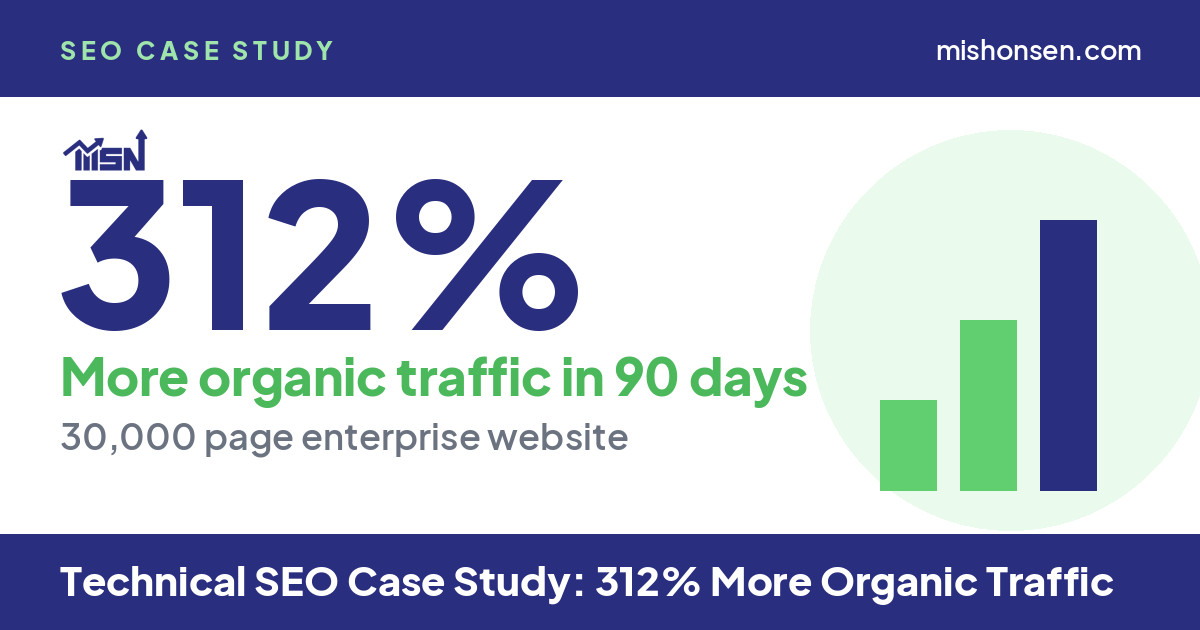
In 90 days, monthly organic visits grew from 5,000 to 20,600, the technical health score went from 54 to 94, and page 1 keywords went from 3 to 45+. This technical SEO case study shows what I fixed and in what order.
The challenge
Large sites break in quiet ways. Nobody notices one redirect chain, one blocked folder, or one slow template. Across 30,000 pages, those small problems add up fast.
- ✓Slow pages. Pages took more than 6 seconds to load, which hurt Core Web Vitals and mobile use.
- ✓Crawl problems. About 40% of important pages were hard for Google to reach because of robots.txt rules, redirect chains, and wasted crawl budget.
- ✓Weak mobile experience. Mobile usability problems touched about half of all visits.
- ✓No clear structure. Hundreds of broken internal links and no clear way to group 30,000 pages.
- ✓12 markets. Each market had its own language and local signals, so one fix rarely fit all.
The core problem
Google was spending its crawl time on low value pages and missing the pages that mattered. Until that changed, more content and more links would not have helped.
The strategy
I followed one rule: fix how Google reaches and reads the site before anything else. The plan had five parts.
- ✓Group the 30,000 pages into clear categories. Products, Services, Resources, and Support, with topic clusters and stronger internal links.
- ✓Remove broken links. Old campaigns had left more than 1,200 dead links behind.
- ✓Control what Google crawls. Block low value pages in robots.txt and point crawl focus to the pages that earn traffic.
- ✓Fix indexing mistakes. Remove no-index pages that were linked from indexed pages, and add valuable pages to the sitemap.
- ✓Fix thin and untitled pages. Improve pages under 300 words and add missing H1 tags.
The execution
The work ran in four stages over 12 weeks.
- 01
Audit and roadmap (weeks 1 to 2)
I crawled the full site, grouped every issue by impact, and built a roadmap. Fixes that helped crawling and speed came first.
- 02
Structure, links, and robots.txt (weeks 3 to 4)
I set up the category structure, removed more than 1,200 broken links, and cleaned up internal links. I used robots.txt to block about 5,000 low value pages and focus crawling on about 3,000 important ones. Google started crawling key pages about 3x more often.
- 03
Indexing and content fixes (weeks 5 to 8)
I fixed no-index conflicts, improved 335 pages under 300 words, and added H1 tags to 86 pages that had none.
- 04
Monitoring and handover (weeks 9 to 12)
I built an automated dashboard, wrote an action plan for the developers, and trained the team so the fixes would hold. Monthly audits continued after launch.
The results
Measured over 90 days against the starting point.
| Metric | Result | Detail |
|---|---|---|
| Organic visits per month | 20,600 | Up from 5,000 (+312%) |
| Technical health score | 94/100 | Up from 54 |
| Page 1 keywords | 45+ | Up from 3, including 12 at #1 |
| Average position | 8.2 | Improved from 28.4 |
| Desktop load time | 1.7s | Down from 6.2s |
| Mobile load time | 2.1s | Down from 8.4s |
| Issues fixed | 10,725 | Broken links, redirect chains, server errors, duplicate content |
| Traffic at day 60 | +150% | Early sign before the full 312% |
| Visibility vs competitors | 68.2% | 45 page 1 rankings, ahead of three rivals with 38, 34, and 28 |
| Monthly revenue | About $127K | Up from $11,150 at the start |
The site got much faster. Desktop load time fell from 6.2 seconds to 1.7 seconds and mobile fell from 8.4 seconds to 2.1 seconds. Core Web Vitals went from failing to passing.
Visitors stayed longer and bought more. Bounce rate fell from 68% to 42%. Pages per session more than doubled, and conversion rate went from 1.2% to 2.8%.
Revenue followed. Monthly revenue grew from $11,150 to about $125,700 by month 3, a run rate of about $127,000 a month.
Return on investment
| Item | Cost |
|---|---|
| Audit and strategy | $3,000 |
| Development | $6,000 |
| Content optimization | $3,500 |
| Tools and software | $1,200 |
| Project management | $1,300 |
| Total | $15,000 |
The project paid for itself in about 14 days and returned 847% in the first 90 days.
On a big site, technical SEO is not a one time fix. It is the base every other SEO task stands on.Mishon SEO consultant & growth partner
Why it works: key takeaways
Five lessons from this technical SEO case study that I now apply to every large site.
Fix the foundation before content and links
Great content cannot rank if Google cannot reach it.
Speed helps rankings and sales
Faster pages improved rankings, engagement, and conversions together.
Big sites need a clear structure early
Clear categories and internal links help both users and crawlers.
Monitoring must be automatic
At 30,000 pages, nobody can check by hand. Dashboards catch problems early.
Thin pages still hurt
Technical fixes do not save weak content. Both need work.
Seven maintenance tips for large sites
- ✓Keep pages close to the homepage. Every page should be within three clicks.
- ✓Give every page the basics. Unique meta tags, a proper heading order, and clear image alt text.
- ✓Aim for load times under 2 seconds. Compress images, minify code, and use a CDN.
- ✓Fix crawl issues fast. Watch robots.txt, broken links, and redirect chains.
- ✓Test on real phones. Mobile first indexing means mobile problems cost rankings.
- ✓Audit every month. Small issues grow quickly on big sites.
- ✓Build technical SEO in from the start. It is cheaper than fixing it later.
Need help with Technical SEO?
I fix crawling, indexing, speed, and site structure so your best pages can rank. I also offer SEO audit if that fits your goal better.